Before we begin our banquet, I would like to say a few words. And here they are: Nitwit! Blubber! Oddment! Tweak!
Albus Dumbledore
The rain splattered the streets of Pensacola, Florida as the brothers, El and Ery made their silent journey to their destination. The house wasn’t hard to find; it was the only one with lighted windows and a smoking chimney at 2 o’clock in the morning. After only two knocks on the door, the brothers were allowed inside.
“I knew you would come eventually,” the owner of the house resumed his seat nearest the fire. He was puffing on a pipe that emitted bubbles, rather than smoke. El and Ery exchanged glances before seating themselves on the velvet sofa.
“Oh, yes I knew you would come,” Sir Sleuthsalot puffed on his faux pipe thoughtfully. “I have read about your missing elements, and I shall take on the case myself! This is why you have sought me at this hour, is it not?”
“Right on all accounts!” El was relieved that they could skip the introduction of the case. Naturally, the press had been all over them for the story, so there wasn’t much to say. “I daresay you have a lead then?”
“Why, I have three leads!” Sir Sleuthsalot stood up dramatically.
“Thank you, detective!” The brothers asked simultaneously.
“I know where our first crime scene is located, let us not waste time!” Sleuthsalot grabbed his coat and beckoned the brothers to follow.
The detective led them to a very dark and partially flooded alleyway. There was a single door at the end of this dark, tunnel-like path, and it was locked.
“Never fear, my friends!” Sleuthsalot rummaged in his pocket and produced a key. “The original crime that took place here has long been forgotten; however, some clues are never too old to be analyzed.” He jammed the rusty key into the rustier lock, and with miraculous luck, the door opened.
After fiddling with the lights, Sleuthsalot revealed that they were standing in the laboratory of the dreaded Dr. Heckle. The brothers remembered hearing tales of the horrible monstrosity Dr. Heckle created that resulted in the murders of many victims and eventually the doctor himself. The brothers watched as Sleuthsalot prowled around the room, searching for something that they obviously did not see.
“Yes, it is just as I expected,” Sleuthsalot chuckled as he straightened up. “Can you, my dear friends, see what is wrong about this scene?”
The brothers looked around with slight creases between their eyebrows. Sure, they could spot the mysterious liquids glinting poisonously in their crystal vials, and they saw the broken glass and smashed tables, but they knew these were not what Sir Sleuthsalot was interested in.
“Give up?” Sleuthsalot asked, still chuckling. “It is because the thing I was looking for isn’t here. There was never a detective on the case for the mysteries of Dr. Heckle! There is one of your missing elements, and you’re very welcome.” He stared smugly at the brothers.
“Well, all right,” the brothers figured that made some sense. “Now, what about the other--”
“We’re already on our way!” Sleuthsalot was halfway out the door before the brothers caught up.
The next crime scene was a secluded house on Paris Ave. Sleuthsalot magically had the key to this building, as well, and the trio was now standing in a very plush and dimly-lit study.
“This, El and Ery, is the study of the famous detective DuPoboy.” Sleuthsalot waited for the brothers to look impressed. Instead, they merely grimaced. “What seems to be the problem?”
“Oh, we’ve read the stories of DuPoboy.” Ery explained.
“But we were never huge fans of his boring explanations on how he solved his crimes.” El admitted, shrugging.
“Ah, but there lies one of your other elements!” Sleuthsalot wagged his finger at the brothers. “DuPoboy’s explanations monopolized his stories. He was also the one doing the detecting, which made him the protagonist of his tale. Don’t you agree?”
“Well, I suppose so—.”
“Then we move on to crime scene number three!” Sleuthsalot paused before he reached the door this time. “However, I appear to be missing an important part for my detective story that is introduced by the DuPoboy tales. I must have a narrator!”
The brothers stared at each other. Neither knew what to tell Sir Sleuthsalot. They both felt that a disembodied narrator was doing just swimmingly.
“Do you feel a narrator is extremely crucial for detective fiction, Sir Sleuthsalot?” El asked the detective.
“No, no,” Sleuthsalot waved his hand impatiently. “The narrator just makes things interesting and keeps the detective company. He is, however, rather handy, and I would like to have one.”
“I don’t mind narrating your sleuthing.” Ery boldly offered himself up for the position.
“Nonsense, neither of you is allowed to narrate!” Sleuthsalot waved his hand impatiently. “I need someone not involved in the crime!” He stepped into the street and grabbed the first man he could find. “Sir, what’s your name?”
“Name’s Greg,” a gruff man who appeared to be homeless answered. “Whatchoo want?”
“I need a narrator to be my companion and to record the multiple cases I shall solve!” Sleuthsalot declared dramatically.
“So, I can live with yas, then?”
“Of course.”
“OK, I’m in.” Greg took over for narrating.
-
The next place this fancy guy with the bubble pipe took us was some house in the middle of town. I tried casing this place once in my day, but I only ended up tackling wax busts of what appeared to be a dude. Man, try latching on to that in the middle of the night. I never walked near this house again—
“Greg, if you want a hot meal and a place to stay, you have to narrate correctly!”
Right, so, now that I have to be a fancy man, I gotta talk real smooth.
Anyway, Sleuthsalot led us into the house and into another study. This one seemed much more interesting than the other house. There were crazy inventions, newspaper clippings, and various instruments strewn across the floor and onto cluttered desks. It seemed a much more lively man studied here than in the other house.
“And this,” Sleuthsalot paused for dramatic effect. “Is the legendary study of E. Teephone Homes, the greatest detective to date!” Now, this time, I saw the faces of El and Ery light up.
“Yes, we were hoping you’d bring us here!” El exclaimed happily as he watched Sleuthsalot begin searching the study. “Mr. Homes has quite the reputation of being a great detective!”
“As he rightly should!” Sleuthsalot sat in the armchair closest to the fire and closed his eyes. It was as if the spirit of E. Teephone Homes was residing in the armchair itself.
I sure hope not, because I don’t mess with no ghosts!
“He has the qualities of DuPoboy, yet he is much more personable and active in solving his crimes. His narrator, Watson is rather charming, too. I must apply for one of these!”
This is the part where I turned angrily from Sleuthsalot and strode for the door. My cardboard box by the beach was sounding better by the minute.
“Oh, Greg, come back!” Sleuthsalot called for him. “I shall enroll you in medical school, and all will be well! You will see!”
I returned to the study to find Sleuthsalot now standing up and the two brothers sitting down.
“So, you see, here are your three elements.” Sleuthsalot held out three fingers and brought one down with each element. “The first one is the detective himself who solves the crime. The crime does not have to have a motive, but it must be a case to crack! The second is the detective being the protagonist of his tale, as DuPoboy exhibited. The third, which rounds out the perfect detective that is E. Teephone Homes, is the use of empirical study and deductive reasoning to solve a crime. Since I am a well-known detective myself, I knew what the three missing elements were from the beginning. I have exhibited the third element perfectly by attending each crime scene and physically looking for clues (or lack thereof) in order to fit them into the big picture. My actions exhibit deductive reasoning and have also solved your crime.”
I turned from Sleuthsalot’s beaming face to El and Ery’s confused ones. They appeared to not be satisfied with my new roommate’s conclusion.
“But, Sir Sleuthsalot,” El began quietly. “We know what the three elements are. We, afterall, came up with them.”
“Oh, well, I knew them already so I did not feel the need to ask you—.”
“But you did not get the third one.” Ery cut Sleuthsalot off. “The detective who detects and the detective being the protagonist are, indeed, the first two elements. The third, however, is the detective triumphing over a criminal of some sort. We came to you, not really to find the three elements separately but to find all three of them together within one detective story.”
At the mention of triumphing over a criminal, I attempted to edge over to the exit. You see, I had some hot watches in the inside pocket of my coat, and I’d rather hang onto them for the time being—
“Get back in here, Greg!” Sleuthsalot snapped. “I must apologize, my dear friends, but I declare your case unsolvable. For you see, I have my own theory as to why your elements never appear to be in the same story at once. All of the elements of detective fiction rely in the act of detection itself. Sure the characters, crimes, and motives might be a little tweaked here and there, but that’s what makes detective novels so interesting. We, as readers, merely need a vehicle through which we can solve the crime or puzzle presented to us.” He fastened the buttons of his coat and took out his bubble pipe. “I hope this act of detection has brought you the answers you need. Come, Greg, we’re off to medical school!”
I happily followed my new partner into the dark and stormy night.
I wrote my story to express how silly the Ellery brothers’ 3 qualities of detective fiction are. According to their list, none of the stories we’ve read are 100% detective fiction, yet they are all undoubtedly forefathers of the detective genre. I started the story with a crime scene similar to Jekyll’s laboratory to show that the crime itself is what initially begins the detecting that takes place in a detective novel. The first two elements are obviously necessary for a true detective novel. Without the detective as the protagonist, the reader would lose sight of actually solving the crime. The greatest detectives, Dupin and Holmes, are both intriguing characters who walk the line between hero and villain. These types of characters intrigue the reader to continue solving the crime with the detective. I had my detective progress through the stories in the order read in class, not only for sequential purposes, but also to show the evolution of the detective novel. From the introduction of the crime and the criminal, (Dr. Jekyll and Mr. Hyde) to the well-developed detective of Victorian England (Sherlock Holmes,) the detective genre has evolved and adapted to the readership of Victorian England. I think my story would be appropriate for Victorian England (minus some of the places and names) because it falls into place with the mainstream detective novels while vouching for the actual detection that initially draws in the reader. It also shows that while the Ellery brothers’ 3 qualities are often good additions to detective novels, they do not (and often are not) simultaneously in a story. I also added the epigraph, because most detective novels have one, and Dumbledore’s words at the beginning of Harry Potter’s first term at Hogwarts have always been a few of my favorites.
Tuesday, April 20, 2010

The Marvelous Augustine-- a satire
The Marvelous Augustine
We were members of that select fraternity, I and my companion, a certain Jean-Baptiste Augustine of whom I had become inordinately fond over the short span of our acquaintance— so fond, in fact, that we had come to inhabit together a house rife with phantasms. They did not bother us, and we did not bother them— we were busily engaged in intellectual pursuits, he and I. It happened one night, as I was scribbling down some transient thought which had settled in my agitated mind, that Augustine stood up, handed me an evening journal, and said, “observe, cher ami, the third column from the right.” Printed there was a story documenting the discovery of the body of Mme. Dupont, found lying in a gutter at two o’ clock that morning. While out on an errand of an unknown nature she had received multiple stab wounds from a similarly unknown blunt weapon and seemed to have been nearly thrown across the street. Seven bones were shattered and there were several puncture wounds in her chest— ah, Paris! Will your thirst for blood ne’er be quenched? Neighbors had reported an unusual and horrible sound, as of a man in pain.
“But that is most strange,” I mentioned to my companion. “Could it be that a man was murdered as well, and the body hidden?”
“A man will be murdered soon enough unless these ignorant gendarmes of ours reexamine their evidence,” he replied. “Their current scenario can’t possibly be correct— M. Dupont, stab his wife in cold blood and then hurl her across the street? The man doesn’t have the strength to throw a cookpot that distance! I suppose,” he said meditatively, “we ought to go set things aright. It’s dark enough— what say you to a journey to the troisiéme?” So saying, my companion donned his sunglasses and off we set.
Upon our arrival a swarthy gendarme attempted to bar us from the scene of the crime, saying we lacked official certification, but a quiet word from my companion and he become suddenly reticent and allowed us to pass unmolested.
“Pray tell, what is this that you whispered in the officer’s ear?” I queried, but Augustine only smiled and said “Save your curiosity for the mystery, mon cher. There are greater things afoot. What’s this?” he said, approaching the victim’s body. “What a curious puncture wound.”
“The instrument must have been curved like a Japanese sword,” I observed.
“It would certainly seem so,” said my companion, bending over the body for a moment. “Very well,” he said, straightening up again. “I’ve seen enough. Let us depart.”
“Is the crime so impenetrable?” I protested. “With your extraordinary ability of deduction, surely you, my dearest friend, can hazard a guess as to the nature of this incident?”
“Any guess I hazard now can be hazarded just as easily at home, where I have my pipe and a comfortable chair to hazard with. Unless you’ve anything else you would like to see, I suggest we depart.
“But you know,” he said as we walked by moonlight, the pavement shining beneath our feet like ethereal silver, “as notions go, I believe I’ve a fairly accurate one. Tomorrow at 10 P.M., we shall see for certain.” And inveigle as I might, he would only smile and say “Tomorrow at ten all shall be made clear.”
And the next night we had a very queer visitor indeed. A rather portly man of British origin came calling. His manner was nervous and his voice overly loud— repeatedly I had to beg him to speak more quietly, for the room was filled with much that was delicate and I and my companion were unaccustomed to loud noises. I led him to the parlor, instructing him to speak very softly around Augustine who was delicately constituted.
“Ah,” Augustine said kindly, “and this would be R. Gables?”
“Sir— why, yes,” said our visitor, rather taken aback. He had not announced himself, and I had seen no need to inquire. “I was led to believe, Monsieur, that is to say…”
“You were led to believe that I and my companion provide a service of shipping exotic animals across France, yes?” Augustine said. “You have an animal of the exotic nature, presumably, which requires said shipping?”
“Yes, Monsieur. I have recently acquired, through no fault of my own, a dwarf wildebeest. I would like it shipped as, well, as discreetly as can be managed, given the unusual circumstances.”
“R. Gables,” Augustine said, “are you aware of the curious circumstances of the death of Mme. Dupont?”
“It doesn’t belong to me,” Gables said nervously.
“I see you are attempting to surreptitiously reach for your weapon. I would not do this,” Augustine said, lifting his hand from the shadowed recesses of the divan, and for a moment I saw the metallic gleam of his revolver. “I am aware that the wildebeest was not originally in your possession. It belonged to an exhibition which is currently travelling through Lyon. The animal’s name, I believe, is Oscar.”
“They’d kill him,” Gables said, “they’d kill him if they knew. That he killed her. He did it. I saw him do it.”
“But you knew, of course, that Mme. Dupont had brought this misfortune upon herself by attempting, very stupidly, to steal the animal.”
“She must have been relocating the animal when I spotted her. Followed her discreetly— wanted to turn them her into the authorities once I knew where she was going. You understand.”
“I do,” Augustine said mildly. “And of course, after seeing Oscar dispose of Mme. Dupont, you very charitably elected to care for him until you could return him to the exhibition where he belonged. Only one thing puzzles me— where have you been keeping the animal?”
“I have a large closet.”
“I see. Well, all is clear to me now. At this address you will find the headquarters of an organization which will be sympathetic to your cause. I have spoken to them already— they will arrange for the transportation of the animal.”
“Thank you, Monsieur,” R. Gables murmured, “God bless you.” I took it upon myself to see him out of our dwelling.
“But mon cher,” I said upon returning, more than slightly puzzled. “Even if the mystery is clear, the solution is not. How did you know the puncture wounds were caused by a wildebeest, of all things?”
“It was simple,” he said. “From the nature of the wounds— you observed yourself that the instrument must have been curved like a Japanese sword— and also from this.” He extricated a piece of brown fluff from his pocket. “In my youth I dabbled in the natural sciences; it was easy enough to determine that this was wildebeest fur, and once I had drawn that logical conclusion I realized it could only have come from Oscar, the missing dwarf wildebeest. It then became my objective to find out who was harboring said wildebeest, and why. I obtained a copy of last week’s paper, in which the disappearance of the wildebeest was noted. R. Gables was thought to be a prime suspect because of his previous close ties to the wildebeest, but his premises were searched and nothing found. I elected to follow the lead anyway— I had some of my associates plant the idea in Gable’s head to come here around ten in the evening on a Tuesday, which is when we supposedly arranged for the shipping of exotic animals. And the rest, as they say, is history.”
“Jean-Baptiste Augustine, you’ve outdone yourself.”
“Always, mon cher. Now pass me my pipe.”
Evaluation
In The Marvelous Augustine, Augustine's ability to solve the crime is heavily dependent on his having read the newspaper, which was a facet of Victorian life, and on his knowledge of natural science, an area which was rapidly expanding. The language is overly flowery
à la Bulwer-Lytton, and I tried to reference The Purloined Letter, in which one never sees the purloined letter, in the way that newspapers in this text hold all the answers and they are never seen. I tried to be relatively faithful to the character of Dupin as well.
Monday, April 19, 2010
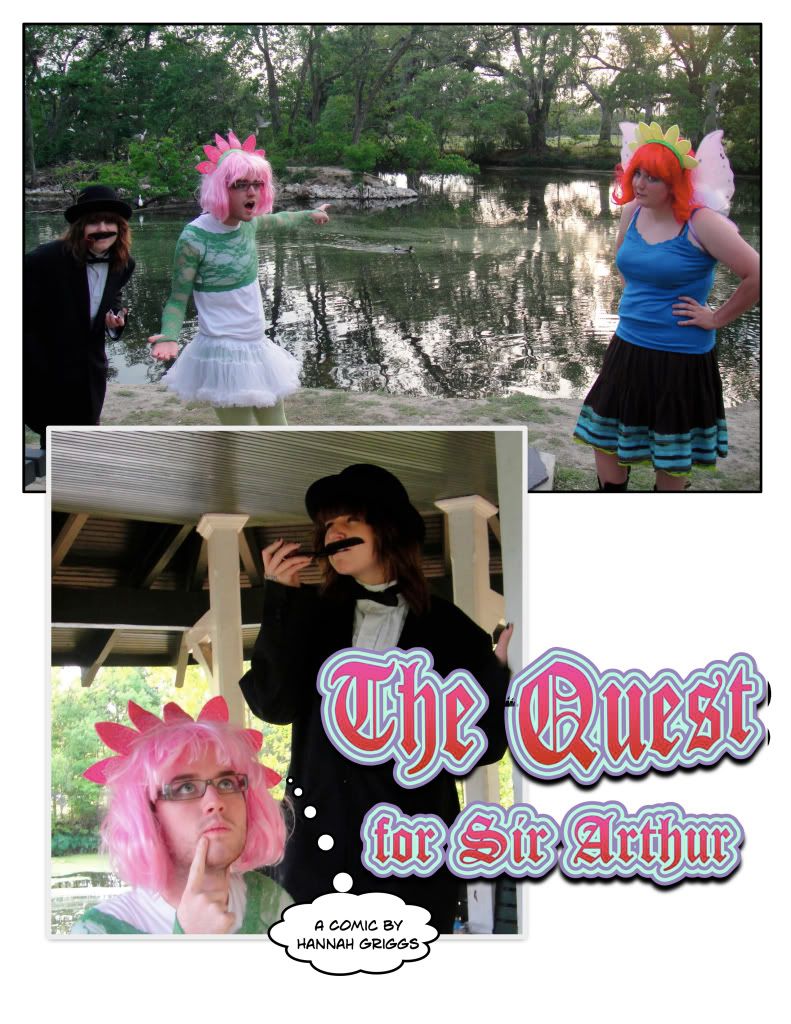
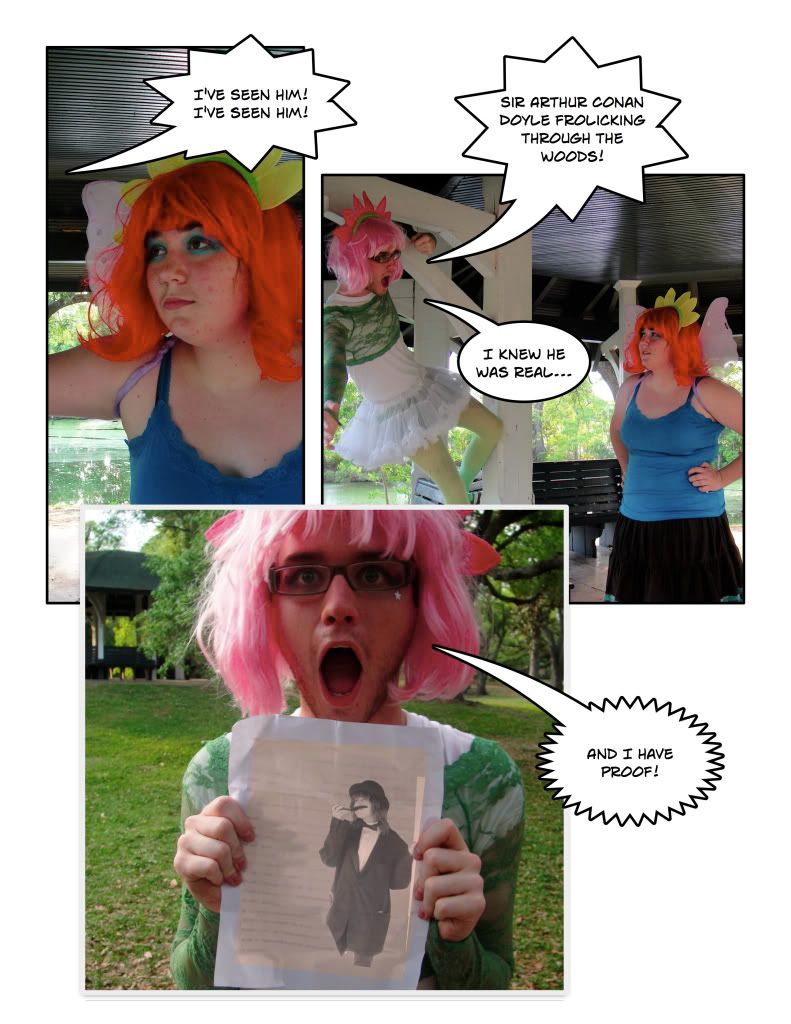
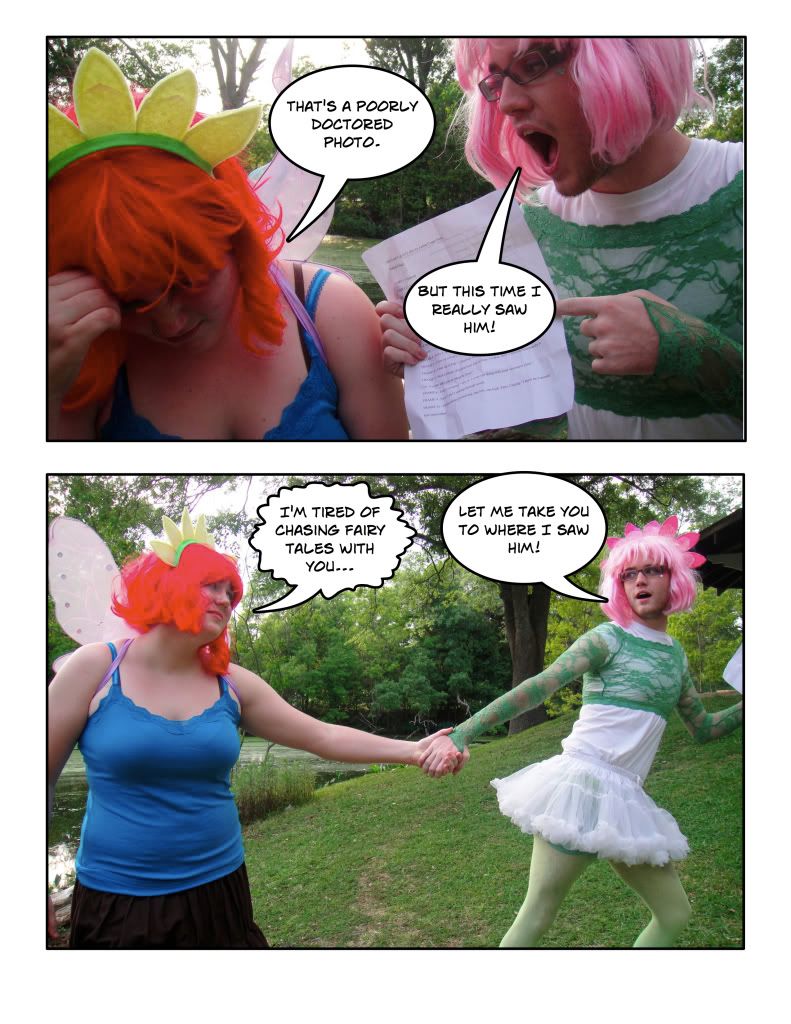
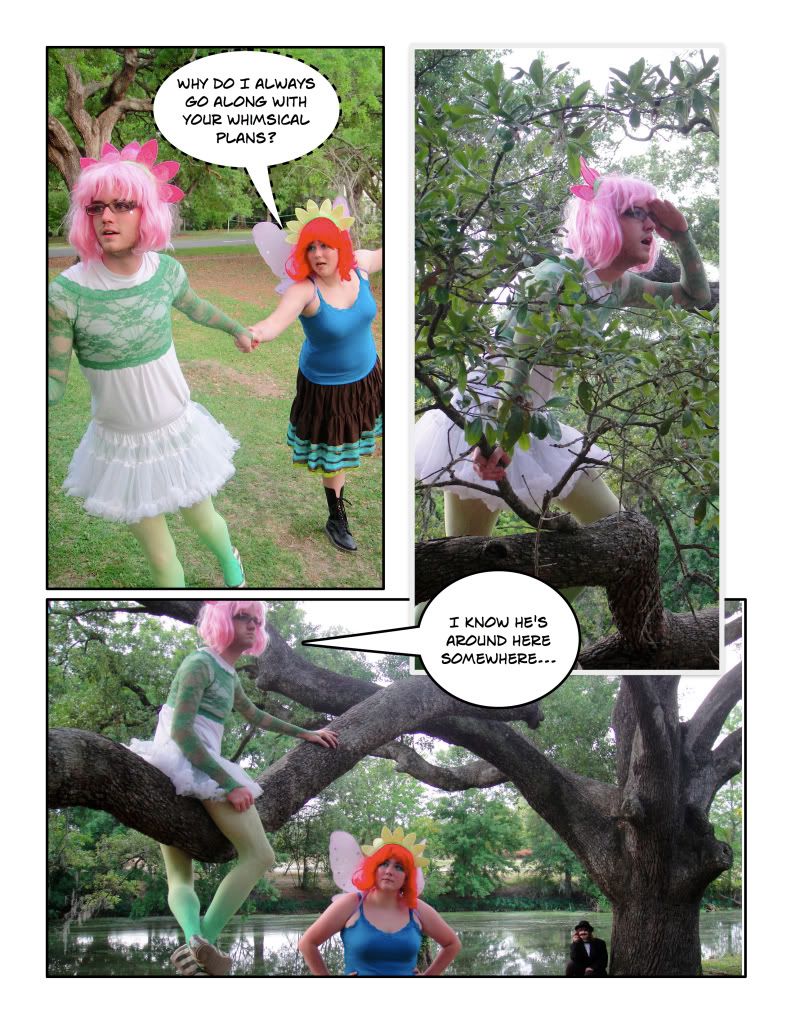
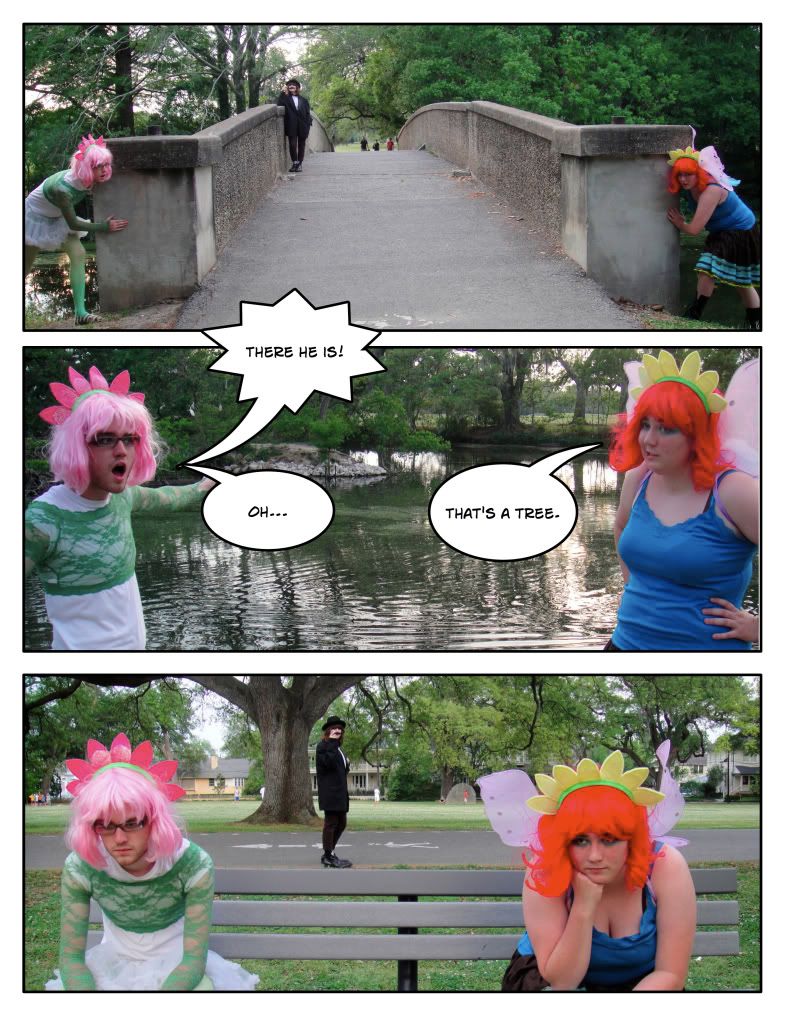
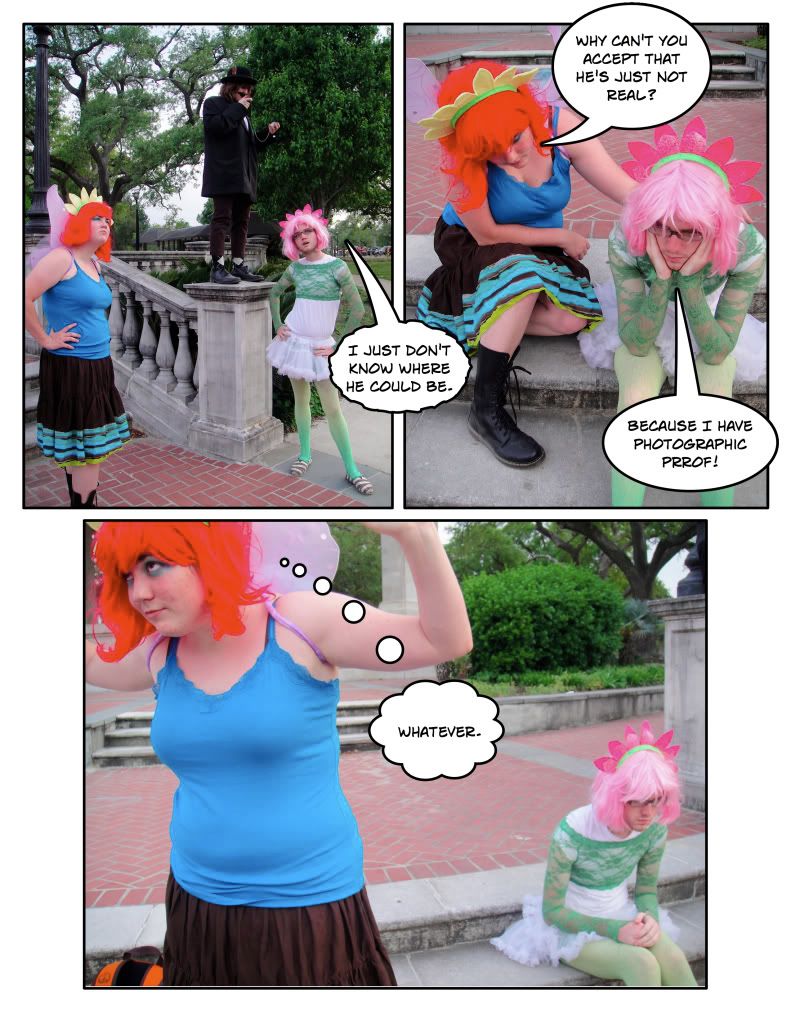
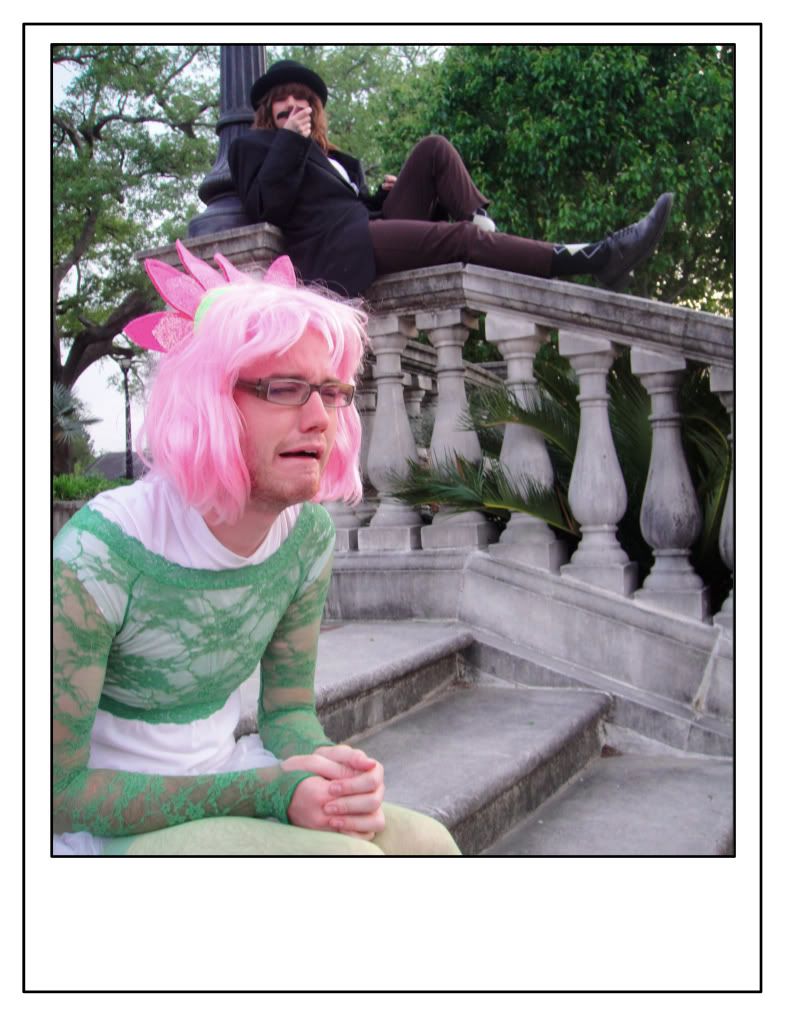
The Quest for Sir Arthur

Page 1, Page 2, Page 3, Page 4, Page 5, Page 6, Page 7
Brief response to my comic, "The Quest for Sir Arthur"
I found Sir Arthur Conan Doyle’s belief in fairies quite interesting, as well as ridiculous. I wanted to satirize that his convictions were entirely based on doctored photographs. I did not (and still do not) understand why such an intelligent man made such assumptions with so little proof. Thus I thought it would be both hilarious and appropriate to reverse the situation. I created two fairies, one of which believed in Sir Arthur Conan Doyle, the other a skeptic.
In order to create some semblance of a detective story, I took into account the Ellery Queen yardstick—a detective story that contains a detective who detects, who must be the protagonist, and must triumph over the criminal. I had a hard time thinking of a story that fit into that mold, so I used only certain aspects of the yardstick formula. I also considered the Strange Case of Dr Jekyll and Mr Hyde, in which Mr. Utterson pursues the bizarre circumstances surrounding Dr. Jekyll on a hunch and meager observations, much like Doyle’s conjecture about fairies. The pink-haired fairy—the protagonist—leads a skeptical fairy around to find an elusive Sir Arthur Conan Doyle, to no avail. It reflects the absurdity of an unsubstantiated hunch, like that of Doyle, Sharpin (in The Biter Bit), and Utterson.
I also wanted to briefly comment on gender roles in Victorian society. The pink-haired fairy, portrayed by my (male) friend Tyler, is dressed in a tutu, tights, skin-tight shirt, and a pink wig with a crown. A woman—Holly—depicts Sir Arthur Conan Doyle in a suit and bowler hat, and dons a moustache. Both defy the traditional female/male standard that Victorians so heavily stressed.
Essentially, I wanted to make fun of Doyle’s ludicrous claims on the existence of fairies. But, like in most of the stories we have read, there is also a serious element under the impractical.
A man solves a crime - or maybe not...
A satirical review of “The Mystery of Marie Rogêt” by Edgar Allan Poe
Constant repetition carries conviction.
- Robert Collier -
Any idea, plan, or purpose may be placed in the mind through repetition of thought.
Any idea, plan, or purpose may be placed in the mind through repetition of thought.
- Napoleon Hill -
Premise.
Hobby detective Monsieur Dupont, called “the Explanator,” and his assistant, who unfortunately has no name, and will further be referred to “the Transmitter” because he originally told the story and fulfilled other delivering tasks, live in a spooky house no one wants to go in. The couple likes that, they do not want to be visited. The Transmitter is a rich man, and he pays for everything since the Explanator lost all his former property – why, nobody really knows, it might not be by his fault. These men are very momentary: they decided to give “the Future to the winds” and to “slumber tranquilly in the Present” (150). See how educated they are? Consider their poetic language! Other people may call their ‘action’ as being very, very lazy, but in the way the Transmitter says it, it sounds to be something reeeeally important and elite.
The Transmitter is very proud of the Explanator because he solved an ‘unsolvable’ murder a couple of years ago. Just by the power of his brain, called inductive reasoning. Isn’t he a smart guy? Of course, he never told this to anyone, so the policemen really admire him since he is so much cleverer than they are. And now, the Police, also known as “the Incapables” have to ask the Explanator for explanations of a crime again. The story will start right now.
Part I: Facts.
The Transmitter is very proud of the Explanator because he solved an ‘unsolvable’ murder a couple of years ago. Just by the power of his brain, called inductive reasoning. Isn’t he a smart guy? Of course, he never told this to anyone, so the policemen really admire him since he is so much cleverer than they are. And now, the Police, also known as “the Incapables” have to ask the Explanator for explanations of a crime again. The story will start right now.
Part I: Facts.
A girl, Marie Rogêt, lower middle class, left the house one Sunday morning and did not come back. Later, she was found in the river. She was obviously killed because her body was treated very badly. But it was unknown how she was murdered. A woman said that it was a gang. However, this can’t be taken too seriously because this woman owns a small pub and on this day, there was a gang that bilked – so by accusing a gang, the woman only wanted to ensure that she will get back her money. After a week of no results, a reward was posted for any hints, and doubled after another week. But nothing happened. Additionally, there are even rumours that Marie Rogêt is not Marie Rogêt. A very sensation-seeking newspaper came up with this idea because it wanted the fiancée to be the murderer, or at least part of a conspiracy. It told the reader that the family did not seem to be shocked by the murder of the girl, and did not show up at the funeral. This was the evidence. The editor did not know or consider, though, that the mother was indeed really shocked, so shocked that she could not do anything during the next days. Circulation is not everything, dear editor.
Part II: more facts.
The Incapables eventually asked the Explanator for help. When he heard of the reward, he acceded. Oh well! He is not always the disinterested, philanthropic man… The Transmitter had to run around the town to get all the newspapers for further information. After one reading, the Explanator knew the newspapers were wrong. He is so smart! He did not even have to go to the crime scene! Unfortunately, the Transmitter was not that clever, so the Explanator had to explain the (logical) falsities. His explanations were very, very long, so here is just one example. “Due to the specific weight of water, at the same time taking into consideration the mineral content, tides, water pollution, a body, which is of the same specific weight, at least most of the time, unless this balance is destroyed by the factors afore mentioned, or human uncontrollable behavior […] the newspaper’s statement is not true.” The Explanator is a very scientific man, as you can see. Regrettably, this makes his way of talking pretty dry and kind of boringly complicated. But the Explanator would not be the Explanator if he did not repeat his explanations. I repeat: he always repeats his main points.
Part III: fade-out…
After reading the newspapers, and rereading them aloud to the Transmitter, he got it. Marie had a secret lover, got into a fight, was killed. Very romantic. Or maybe not? Poe, the author, based this story on a real one in New York. Shortly before publication, he found out that he was wrong: In fact, Marie died because of a fatal abortion. Clever as he was, and not wanting to be claimed for wrong solutions, he included some very small hints in his story that this was also a possibility. He went into the trap the Explanator accuses the police to do: there were lots of possibilities, and he chose the one he wants to be the reason. Just in case you did not get the hints in the story: reread it. The Explanator knows why he always repeats what he is saying. I repeat: he always repeats his main points.
So, the Explanator found two fatal causes. A crime without a conviction, without a “that’s it, here is the murderer” ending? Very unsatisfying. Attention: this could be another hint. The crime might not be so important at all. But what else? Come on, use your logical capacities!
(A not so short) Explanation
We said that the beginning of detective stories was an intrusion into the Victorian privacy at the same time. The detective exposes what has been kept as a secret or at least was not made public. Dupin is a bit contradictory in this aspect because in "The Mystery of Marie Rogêt" he (arguably) solves the crime by discovering a very private affair, the secret lover, and thus would be able to publicly embarrass Marie's family and her reputation, but finds this out by referring to newspaper articles alone. This is a bit scary because it shows how easily a facade can be destroyed. Technically, this method is less intrusive than investigation on-site as Dupin does not get in contact with the family, but in reality, this procedure is rather unrealistic.
“The Mystery of Marie Rogêt” is, in my opinion, the driest of all three detective stories, despite some clever moments when Dupin exposes the ploys and falsities of the newspapers that only want to get a high circulation and therefore jump to conclusions. I mention this in my satire because it shows how sensationally minded the Victorian public can be despite the overall mention of the value of privacy. Besides, this critique is still very topical today.
My satire is divided into an epigraph and four parts. As the original opens with a quote by Novalis about coincidence and how humans and circumstances influence events, thus refers to the fact that the mystery of Marie Rogêt is complicated by a lot of different statements and “evidences,” my epigraph highlights repetition because it completely dominates the story. Dupin always repeats what he considers to be most important in order to ensure that his assistant (and thus the reader) will get the point. But honestly, I was kind of annoyed by the repetition of newspaper articles, so I exaggerated Dupin’s and the story’s repetition by the frequent use of same words in one sentence.
Also, this constant repetition reminded me of something we discussed at the beginning of the semester: the education system in Victorian England. In "Water Babies" and "Alice's Adventures in Wonderland," it is criticized that children have to "learn" through repetition/memorizing. By overemphasizing this, I criticize the lecturing character of the Dupin stories. We said that parents in the Victorian age often expected a story to be teaching. Though the Dupin stories are not children's books, the teaching moment can be found there, too. Dupin always explains how he gets to his conclusion/solutions. Poe allows the reader to follow Dupin’s /his way of thoughts, but makes it almost impossible to get to conclusions by oneself since not everything is told at the moment it happens. For example, it is not mentioned that Dupin picks up a bunch of hair when he examines the crime scene in the story “Murder in the Rue Morgue.” Only when Dupin needs it as evidence for his explanation, the reader gets to know it. So the reader relies on Dupin and his explanations in order to get to the solution. Therefore, I nicknamed the detective in my story, since nicknames can indicate a special character trait or behavior. The assistant is nicknamed, too. “The Transmitter” shall emphasize that he plays an important part in communicating the story to the reader, but does not contribute to the investigation through own observations. He only follows Dupin’s explanations. The police’s nickname, “the Incapables” is given from Dupin’s (arrogant) perspective and the general impression that is created by Poe.
The first part serves as an introduction to the main characters (and therefore not only bases on the story at hand but on “The Murder in the Rue Morgue” as well). There are some hints at the peculiar character of the detective and his assistant and their relationship, e.g. that they do not like visitations, and Dupin’s slightly decrying way to talk about the police and other “investigators” by highlighting his superior qualities and position at the same time. I found it interesting that Dupin, who, in his function as a detective, finds out other people's deepest secrets, is kind of a secret himself as we do not get to know a lot of his background. He can almost be seen as the representation of the Victorian demand of privacy.
I named the detective DuPont instead of Dupin because of two reasons. First, DuPont sounds alike to Dupin. Second, DuPont is one of the most popular last names in France, almost a cliché, the typical French name. Likewise, Dupin serves as a role model for following detectives such as Sherlock Holmes, and the composition of detective stories. "Part II: more facts", is titled this way as an allusion to the original, in which Dupin gathers facts from newspapers and reconsiders them. “More facts” also alludes to the repetitive character of the story, the re-told newspaper articles. Additionally, this title, as well as the title of Part I, is meant ironically because the newspaper “facts” are mostly guesses instead of proved evidence. And as mentioned above, Dupin does not go to the crime scene in order to prove the “evidence.” I picked up Dupin’s long, long way of explaining the situation at hand by giving an example of his argumentation – a completely fictitious one, but one that refers to the explanation of the “water density” discussion. This “quote” presents Dupin as a very scientific man, but also highlights that this makes his descriptions pretty complicated and dry. Again, this can be understood as a further reference to the education system and the rising importance of science in Victorian England.
Part III is named “fade out” because I had the feeling that the original does not have a clear end, at least not an end as I expected it from a detective story. I reckoned with a clear solution, i.e. that the murderer is named and presented to the police. Instead, there is this ‘romantic’ (in its general meaning, not referred to the Romantic period) idea of a secret lover plus the confusion about the fatal abortion, a concept that is more than hidden in the text. It is more like one has to know this possibility in order to find the hints in the story. Inductive reasoning, as practiced by Dupin, is barely possible. Instead, the reader has to act like Sherlock Holmes or Poe, who use deduction.
Reference
Poe, Edgar Allan. "The Mystery of Marie Rogêt." Selected Tales. Oxford, New York: Oxford University Press, 1998. 149-92.
Poe, Edgar Allan. "The Murders in the Rue Morgue." Selected Tales. Oxford, New York: Oxford University Press, 1998. 92-122.
Part II: more facts.
The Incapables eventually asked the Explanator for help. When he heard of the reward, he acceded. Oh well! He is not always the disinterested, philanthropic man… The Transmitter had to run around the town to get all the newspapers for further information. After one reading, the Explanator knew the newspapers were wrong. He is so smart! He did not even have to go to the crime scene! Unfortunately, the Transmitter was not that clever, so the Explanator had to explain the (logical) falsities. His explanations were very, very long, so here is just one example. “Due to the specific weight of water, at the same time taking into consideration the mineral content, tides, water pollution, a body, which is of the same specific weight, at least most of the time, unless this balance is destroyed by the factors afore mentioned, or human uncontrollable behavior […] the newspaper’s statement is not true.” The Explanator is a very scientific man, as you can see. Regrettably, this makes his way of talking pretty dry and kind of boringly complicated. But the Explanator would not be the Explanator if he did not repeat his explanations. I repeat: he always repeats his main points.
Part III: fade-out…
After reading the newspapers, and rereading them aloud to the Transmitter, he got it. Marie had a secret lover, got into a fight, was killed. Very romantic. Or maybe not? Poe, the author, based this story on a real one in New York. Shortly before publication, he found out that he was wrong: In fact, Marie died because of a fatal abortion. Clever as he was, and not wanting to be claimed for wrong solutions, he included some very small hints in his story that this was also a possibility. He went into the trap the Explanator accuses the police to do: there were lots of possibilities, and he chose the one he wants to be the reason. Just in case you did not get the hints in the story: reread it. The Explanator knows why he always repeats what he is saying. I repeat: he always repeats his main points.
So, the Explanator found two fatal causes. A crime without a conviction, without a “that’s it, here is the murderer” ending? Very unsatisfying. Attention: this could be another hint. The crime might not be so important at all. But what else? Come on, use your logical capacities!
(A not so short) Explanation
We said that the beginning of detective stories was an intrusion into the Victorian privacy at the same time. The detective exposes what has been kept as a secret or at least was not made public. Dupin is a bit contradictory in this aspect because in "The Mystery of Marie Rogêt" he (arguably) solves the crime by discovering a very private affair, the secret lover, and thus would be able to publicly embarrass Marie's family and her reputation, but finds this out by referring to newspaper articles alone. This is a bit scary because it shows how easily a facade can be destroyed. Technically, this method is less intrusive than investigation on-site as Dupin does not get in contact with the family, but in reality, this procedure is rather unrealistic.
“The Mystery of Marie Rogêt” is, in my opinion, the driest of all three detective stories, despite some clever moments when Dupin exposes the ploys and falsities of the newspapers that only want to get a high circulation and therefore jump to conclusions. I mention this in my satire because it shows how sensationally minded the Victorian public can be despite the overall mention of the value of privacy. Besides, this critique is still very topical today.
My satire is divided into an epigraph and four parts. As the original opens with a quote by Novalis about coincidence and how humans and circumstances influence events, thus refers to the fact that the mystery of Marie Rogêt is complicated by a lot of different statements and “evidences,” my epigraph highlights repetition because it completely dominates the story. Dupin always repeats what he considers to be most important in order to ensure that his assistant (and thus the reader) will get the point. But honestly, I was kind of annoyed by the repetition of newspaper articles, so I exaggerated Dupin’s and the story’s repetition by the frequent use of same words in one sentence.
Also, this constant repetition reminded me of something we discussed at the beginning of the semester: the education system in Victorian England. In "Water Babies" and "Alice's Adventures in Wonderland," it is criticized that children have to "learn" through repetition/memorizing. By overemphasizing this, I criticize the lecturing character of the Dupin stories. We said that parents in the Victorian age often expected a story to be teaching. Though the Dupin stories are not children's books, the teaching moment can be found there, too. Dupin always explains how he gets to his conclusion/solutions. Poe allows the reader to follow Dupin’s /his way of thoughts, but makes it almost impossible to get to conclusions by oneself since not everything is told at the moment it happens. For example, it is not mentioned that Dupin picks up a bunch of hair when he examines the crime scene in the story “Murder in the Rue Morgue.” Only when Dupin needs it as evidence for his explanation, the reader gets to know it. So the reader relies on Dupin and his explanations in order to get to the solution. Therefore, I nicknamed the detective in my story, since nicknames can indicate a special character trait or behavior. The assistant is nicknamed, too. “The Transmitter” shall emphasize that he plays an important part in communicating the story to the reader, but does not contribute to the investigation through own observations. He only follows Dupin’s explanations. The police’s nickname, “the Incapables” is given from Dupin’s (arrogant) perspective and the general impression that is created by Poe.
The first part serves as an introduction to the main characters (and therefore not only bases on the story at hand but on “The Murder in the Rue Morgue” as well). There are some hints at the peculiar character of the detective and his assistant and their relationship, e.g. that they do not like visitations, and Dupin’s slightly decrying way to talk about the police and other “investigators” by highlighting his superior qualities and position at the same time. I found it interesting that Dupin, who, in his function as a detective, finds out other people's deepest secrets, is kind of a secret himself as we do not get to know a lot of his background. He can almost be seen as the representation of the Victorian demand of privacy.
I named the detective DuPont instead of Dupin because of two reasons. First, DuPont sounds alike to Dupin. Second, DuPont is one of the most popular last names in France, almost a cliché, the typical French name. Likewise, Dupin serves as a role model for following detectives such as Sherlock Holmes, and the composition of detective stories. "Part II: more facts", is titled this way as an allusion to the original, in which Dupin gathers facts from newspapers and reconsiders them. “More facts” also alludes to the repetitive character of the story, the re-told newspaper articles. Additionally, this title, as well as the title of Part I, is meant ironically because the newspaper “facts” are mostly guesses instead of proved evidence. And as mentioned above, Dupin does not go to the crime scene in order to prove the “evidence.” I picked up Dupin’s long, long way of explaining the situation at hand by giving an example of his argumentation – a completely fictitious one, but one that refers to the explanation of the “water density” discussion. This “quote” presents Dupin as a very scientific man, but also highlights that this makes his descriptions pretty complicated and dry. Again, this can be understood as a further reference to the education system and the rising importance of science in Victorian England.
Part III is named “fade out” because I had the feeling that the original does not have a clear end, at least not an end as I expected it from a detective story. I reckoned with a clear solution, i.e. that the murderer is named and presented to the police. Instead, there is this ‘romantic’ (in its general meaning, not referred to the Romantic period) idea of a secret lover plus the confusion about the fatal abortion, a concept that is more than hidden in the text. It is more like one has to know this possibility in order to find the hints in the story. Inductive reasoning, as practiced by Dupin, is barely possible. Instead, the reader has to act like Sherlock Holmes or Poe, who use deduction.
Reference
Poe, Edgar Allan. "The Mystery of Marie Rogêt." Selected Tales. Oxford, New York: Oxford University Press, 1998. 149-92.
Poe, Edgar Allan. "The Murders in the Rue Morgue." Selected Tales. Oxford, New York: Oxford University Press, 1998. 92-122.
Tuesday, April 13, 2010


Monday, April 12, 2010
Sir Arthur Ignatius Doyle

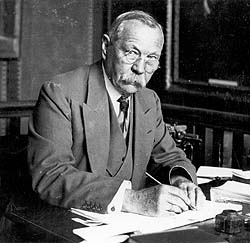
Sir Arthur Ignatius Doyle was born May 22, 1859 in Edinburgh, Scotland, to a father of Irish descent, Charles Altamont Doyle, and Irish mother, nee Mary Foley. He was educated at the Royal Infirmary in Edinburgh where he received his medical degree in 1881. In 1882, Doyle joined a former classmate, George Budd as his partner at a medical practice in Plymouth, but their relationship proved to be difficult, and Doyle soon left to set up his own practice. Arriving in Portsmouth in June of that same year with less than 10 Euro to his name, he set his practice in at 1 Bush Villas in Elm Grove, Southsea. The practice had little to no clientele; while waiting for patients, Conan Doyle began writing stories. His first significant work was A Study in Scarlet, which appeared in Beeton’s Christmas Annual for 1887 and featured the first appearance of Sherlock Holmes, who was partially modeled after his former university professor Joseph Bell, to whom Conan Doyle wrote “It is most certainly to you that I Sherlock Holmes…round the centre of deduction and inference and observation which I have heard you inculcate I have tried to build up a man.” Future short stories featuring Sherlock Holmes were published in the English Strand Magazine. Robert Louis Stevenson was able,even in faraway Samoa, to recognize the strong similarity between Joseph Bell and Sherlock Holmes: “My compliments on your very ingenious and very interesting adventures of Sherlock Holmes…can this be my old friend Joe Bell?” Other authors sometimes additional influences—for instance, the famous Edgar Allen Poe character, C. Auguste Dupin.
Doyle was a prolific writer whose other works include science fiction stories, historical novels, plays and romances, poetry, and non-fiction. His historical romances, includes Micah Clarke (1889) and The White Company (1891). His play A Story of Waterloo (1894) was one of Sir Henry Irving’s, a popular Victorian Era actor, notable successes. Doyle also wrote two political pamphlets; one being The War in South Africa: Its Cause and Conduct, which justified Great Britain’s actions in the South Africa war. Doyle believed that such literary contributes got him Knighted in 1902. In 1885, he married Louisa Hawkins, known as “Touie”, who suffered from tuberculosis and died on July 4, 1906. Doyle then married Jean Elizabeth Leckie in 1907, whom he had first met and fallen in love with in 1897. He had maintained a platonic relationship with her while his first wife Louisa was still alive, out of loyalty to her. Jean dies in London on June 27, 1940. Doyle had five children, two with his first wife Mary Louise and Arthur Alleyene Kingsley, known as Kingsley, and three with his second wife, Denis Percy Stewart, Adrian Malcolm and Jean Lena Annette. In his later years, Doyle became an ardent spiritualist and wrote a History of Spiritualism (1926) and The Land of Mist. He became so involved with Spiritualism to the extent that he wrote a book entitled The Coming of the Fairies (1921) which showed he was apparently convinced of the veracity of the Cottingley Fairies photographs that proved to be a hoax decades later. Doyole would die of heart attack at age 71 on July 7, 1930.
Sunday, April 11, 2010
The Biter Bit- In Class Discussion
A Biter Bit: someone who has caused harm to other people in the past and has now been hurt
As a class, we decided to compare and contrast Poe's character, Dupin, to Collins' character, Sharpin.


As a class, we decided to compare and contrast Poe's character, Dupin, to Collins' character, Sharpin.


Subscribe to:
Posts (Atom)