My literary background consist mostly a proficiency in modernism; from African American literature to southern literature I’ve come to understand that most, if not all modernism, focus on “place”. Prominent authors such as Faulkner, Chopin, Wright, Chestnut, and Cather are major figures in literature because they captured a modernist perspective on their region. For Willa Cather, it is the frontier and plains. For Faulkner it is Yoknapatwapha. For Wright it is the Afro-American’s journey from a segregated south to “supposed” freer north. To me, these authors basically took snap shots of a relative young nation—America--- coming into its own, all the while licking its wounds from the Civil War. When I think of “place” in America, instantly what come to mind is these wide open spaces that, in turn, reflect the big picture according to that author’s regional sensibility.
Since starting this course, I’ve learned that Victorian literature is not so concerned about the big picture, as it is about insidious details. These details are purposely planted to turn an American, such as myself, into a proper Victorian young woman. Victorian literature/England is a curious place where nonsense can make prefect sense, morals are forced to be practiced, and one is can be an outsider as well an insider. My first informal blog I spoke about Victorian literature being an investigation into oneself. I was wrong; I’ve learned that this genre is an investigation on EVERYTHING! Everything as it pertains to our existence: man, woman, child, Victorians, Americans, Afro-Americans… Every text we’ve read has this undermining question—do you want to stay who and what you are or do you want to change/evolve into “whatever”? Each author presented us with the “whatever” we could change/evolve into.
Since this genre encompass a time in England’s history where everything is at its apex, to me, its relevance lies in what is to come by recognizing where we are at present and how we came to be here. Dr. Schwartz kind-of touched on this when we were discussing either Coming Race or Time Machine. She made a comment on the President’s mission to invest in science and math, leaving the arts behind because apparently nothing needs to be done to persevere and enhance arts education. Using either Coming Race or Time Machine as a paradigm Dr. Schwartz opened up my eyes to what is to come, if we as nation take the President’s heed to investing mainly in science and math. I left class extremely disturbed. Not only did she add twenty more layers of literary meaning for me, she also clued me into an insidious event happening right in front my face. So many things came together for me after that class. My approach to understanding Victorian England is that it’s a meditation of what’s to come, in opposing to modernism, which a meditation what has past.
Tuesday, March 16, 2010

Monday, March 15, 2010
On Victorian England
While I always knew that I liked Victorian England in a vague old-things-are-good sort of way, I didn't realize exactly how strongly I felt about it until reading The Coming Race and The Time Machine. Both of these novels focus on the adventures of an intelligent, well-educated man from Victorian England who is thrust into a world full of stagnation and corruption. While reading these books, I was surprised to find myself thinking that I wanted to go home-- not to my own time, but to a time of explosive growth as far away from the stagnation as possible. To Victorian England.
It makes me think of interesting lighting and architecture, an endearingly convoluted social code, and, above all, science without all of the stifling regulations which have in the present day been necessarily imposed upon it-- raw science, perfectly fitted to narrative. Victorian scientists didn't work for a corporation. They didn't have to vie for sponsorship. They were heroes. [Be forewarned: I prefer to err on the side of effusive melodrama.] Here on the other side of the Atlantic, we like to believe that we've patented rugged individualism-- we are the land of the cowboy, the frontiersman, the common-sense protestant founding a home in the wilderness. And we have, and we are. But England has a similarly heroic tale which is more nuanced and can be less compelling to some as a result. Charles Darwin didn't ride into town on horseback and save the local populace from a menacing villain. But he carved his way through the thickets of the unknown and illuminated an entire branch of science, nay, science as a whole, and as a result civilization-- and how? By setting out on a voyage, embarking on a solitary endeavor to chronicle the animals of the Galapagos.
It makes me think of interesting lighting and architecture, an endearingly convoluted social code, and, above all, science without all of the stifling regulations which have in the present day been necessarily imposed upon it-- raw science, perfectly fitted to narrative. Victorian scientists didn't work for a corporation. They didn't have to vie for sponsorship. They were heroes. [Be forewarned: I prefer to err on the side of effusive melodrama.] Here on the other side of the Atlantic, we like to believe that we've patented rugged individualism-- we are the land of the cowboy, the frontiersman, the common-sense protestant founding a home in the wilderness. And we have, and we are. But England has a similarly heroic tale which is more nuanced and can be less compelling to some as a result. Charles Darwin didn't ride into town on horseback and save the local populace from a menacing villain. But he carved his way through the thickets of the unknown and illuminated an entire branch of science, nay, science as a whole, and as a result civilization-- and how? By setting out on a voyage, embarking on a solitary endeavor to chronicle the animals of the Galapagos.
The Victorian era mirrors the Renaissance in that humanity had once again fallen desperately in love with itself. From Mowgli, who tames the wild jungle with his knowledge and his red flower, to Alice and Wonderland, in which one small girl is given the terrifying task of bringing order to absolute chaos-- to The Ascent of Man, which is sung in a minor key but is nonetheless a love song. And further, to The Coming Race and The Time Machine, where again we are asked to identify with a solitary individual-- a hero-- who is thrust into a nightmare which is ghastly and horrid precisely because it is what our world is not. It is entirely alien. It is stagnation, and is completely antithetical to the one image from this course which I will always retain-- growth, pure and effusive, a growth which is dangerously exponential and has not yet learned to control or regulate itself but continually overflows its container-- and the solitary man, a Darwin or a Time Traveller or a Sherlock Holmes, relentlessly hurtling forward, cataloging species, endlessly inventing and deducing, completely and recklessly intoxicated by his ability to manipulate the world around him.
Oh, and as to how this relates to the modern era: we have recently found ourself in another time of terrifyingly exponential progress-- arguably we hit our stride during the Victorian era and have not stopped. But I think the Victorian era is relevant because it does exactly what good literature should do-- shows us not only what humanity can accomplish, but what it can destroy. The social problems of Victorian England should caution us against being too rash in our endless pursuit of progress. Perhaps a steady, more regulated pace is preferable. But not nearly as exciting, which is why more books from this period should be read and more books about this period should be written.
Awesome Make-Up Blog
It seems that we've approached Victorian England from a modern, post-colonial perspective. In the children's novels we've read, we point out the portentous and the sinister underneath all of the naiveté. In The Jungle Books, for example, Kipling carefully constructs his ideology within the story so that we identify--and even sympathize--with Mowgli, the embodiment of colonization. Today, we understand the concept as bad and harmful, but Kipling does a damn good job at convincing the reader otherwise.
The "warnings" that hover over the texts in both The Time Machine and The Coming Race can serve as a second example for our perspective. We certainly see the consequences of a world without the humanities in these texts--the Vril-ya and the Eloi are both on the surface a flawless race, but behind that are serious afflictions, all caused by "evolving past" art.
This hindsight perspective can certainly apply to modern society, but unfortunately, history always repeats itself; such patterns are never noticed and warnings never heeded. To use an example from class, the current administration is pushing a more science and math-based education (a link to an article is here). This was done in the 1960's, and we have created a monster. Apparently Obama never read The Coming Race.
The "warnings" that hover over the texts in both The Time Machine and The Coming Race can serve as a second example for our perspective. We certainly see the consequences of a world without the humanities in these texts--the Vril-ya and the Eloi are both on the surface a flawless race, but behind that are serious afflictions, all caused by "evolving past" art.
This hindsight perspective can certainly apply to modern society, but unfortunately, history always repeats itself; such patterns are never noticed and warnings never heeded. To use an example from class, the current administration is pushing a more science and math-based education (a link to an article is here). This was done in the 1960's, and we have created a monster. Apparently Obama never read The Coming Race.
Sunday, March 14, 2010
"Victorian England" - a thought-provoking impulse!
Before this class, I unknowingly expected Victorian literature and life to deal with domesticity, honor, reputation, and families in a pretty prudish and chaste way (btw: my dictionary names “Victorian” as a synonym for ‘prudish’). Fortunately, I seem to be wrong: the texts we read so far all deal with some kind of travel: a travel into a world unknown but still (pretending to be) real (Jungle books), a travel into a more mystical world (water babies), a travel in one's dream (Alice), a travel below the surface of the Earth (Coming Race), and a travel in time (Time Machine, The Ascent of Man). Though the act of travelling does not always play the main part, it is still important. All protagonists happen to get into another world where a lot is unfamiliar. It seems that the authors have to let them go to different worlds where they are confronted with different systems in order to communicate ideas which might otherwise be seen as too modern, too provocative, radical, or would just disappear unheard.
There are the stories of The Jungle Books which present and justify British behavior as Imperial Destiny and well-educated, “civilized” human superiority as a natural power. However, there are some ambiguous moments, e.g. when Rikki-Tikki, the “savage,” saves the colonizer’s life, or the epigraph at the beginning of Toomai and the Elephants. Once started looking for other options, it becomes clear that Kipling’s novel offers very different readings, open to almost every interpretation. One point that was especially important and interesting for me is how (natural) law and freedom coalesce in the Mowgli- stories, and in Mowgli himself. We (and when I say ‘we,’ I mean it in the sense of 21st-century-, Western world-, and educated readers) think of a lot of these topics different than the Victorians did. For example, we do not support or justify the idea of colonizing “savage” people in general, yet there is still a difference between “First World” and “Third World,” the mighty, industrial nations and the poor countries, classified as being in great need of development, thus not as progressive and modern as “we” are. Kipling’s stories might let us think of our ‘modern’ self-understanding and how we see the world. And question it: being confronted with the still apparent disparities today, it seems as if we did not make as much progress in our mindset concerning the power-relations in the world as we might have thought. The second point, the connection between law, nature, and freedom is also still relevant today or maybe even more than ever before. As I argued in my post about the moral of the jungle book, Mowgli and the animals of the jungle eventually manage to live in accordance with the natural, eternal law (at least in the stories we read). This leads me to question the role of our society, what freedom means for us, where nature takes part in our lives, how we define (and justify) our position, and on which rules we base our life. I am far away from knowing the answers, but The Jungle Books was the thought-provoking impulse.
Going from the world of the jungle to the world underwater, we get to know a different part of Victorian society: Kingsley parodies the Victorian educational system by using Tom, former chimney-sweep and now a water-baby, as a model to support his ideal of education through experience, and of an evolution of ideas. The final goal, however, is still to ‘get’ a proper Englishman. I think the method and value of education are always worthwhile to consider. ‘What do I learn, how do I learn, why do I learn?’ are important questions. Kingsley presents us one way (metaphorically seen, I mean, we can’t transform into water-babies). Moreover, he shows us through Tom that education can be a means to develop a sense of one’s identity.
As in Water-Babies, Alice’s Adventures in Wonderland also confronts us with the ever challenging question “Who am I?” Alice defines herself in relation to well-known conventions; she does not have the “right” size according to her Victorian knowledge and experience. She feels uncomfortable in the new world and questions her position, has to find out who she is and where she belongs (or wants to belong). And so do we.
Alice challenges me. She is so ambiguous, first apparently stupid, then instinctual. She changes our understanding of her, and thus our understanding of the system, the world she happens to be in. Does she make progress? In some sense yes, as she begins to understand this totally different system down the rabbit hole, and is finally able to find the way out by realizing the world’s real character: everything is nonsense. There might be a critique of the Victorian obsession with order and the expectation of a moral in every story. Maybe we, too, have to accept that not everything has to have a reason, an explanation. Some things just are. I just have to think of the ‘miracle of life’ and how some people desperately try to resolve it (well, this is a bad example, it does not really match…). We also questioned if Alice’s adventures can be seen as a form of escapism, in her case to get away from the ‘boring’ world above (cf. the books without pictures). This question becomes even more important when we think of the new “Alice in Wonderland” film by Tim Burton. There, the way down the rabbit-hole is clearly shown as her solution to get away from this awful betrothal, she literally runs away from this difficult situation, exactly as little Alice changes the setting when she dislikes a scene. Even if this novel is complete nonsense, it still offers a cheerful escape from reality for some hours. And I think this is something that should not be underestimated.
The Coming Race, The Time Machine, and the Blind, Kendall and Naden poems all deal with evolution of men in some sense, but focus on different things. What they all have in common is that they show that mankind, though supposed to be the apex of evolution, will eventually descend. There is this certain fear of degeneration. The Vril-ya, being in possession of the one idea/concept/power that encompasses everything, pretend to be perfect. But in fact, they are not. They lack ambition for progress and lost a sense for the arts. And it is clearly stated out that standstill cannot preserve perfection. This stagnancy finally has to lead to their own destruction. In The Time Machine, art still exists, but it is separated from ‘dirty’ work. Neither the happy Elois, the representatives of an aesthetic value, nor the gloomy Morlocks, the embodiment of industrial work and technologic knowledge, are an attractive alternative to contemporary Man. It is a pretty dark and somber outlook. A lot of the poems somehow mention the wish for a second chance, a new start of evolution. And the idea is presented that man and the ‘lower’ creatures are in fact not as far from each other as many suppose. There is the expectation that the way “creation of the world – lower organisms – fishes, birds – mammals – man” finally goes back to chaos, to the beginning. Thus the devolution of Man is predicted. In yearning for perfection, mankind will (unknowingly?) overshoot the mark, and cause its own end. Furthermore, it is arguable if man is the apex of evolution at all. The poems, at least, indicate this. And according to Darwin, evolutionary development can rather be compared to a spider’s web than to a linear progress, so the superior position of men becomes more and more questionable. I found it interesting how the poems discuss mind vs. physical features, and state that this often creates issues, such as in The Lower Life: “The gaining of a higher goal/ Increaseth sorrow” (ll. 26-27). Though the consideration in which direction mankind will develop and how we create our future is an important and interesting one, I am more intrigued by the art vs. science discussion. As we can see today, the predicted direction towards science has become true. If there is money to spend, it will be spend in order to make further improvements in technology and science. I do not say that this is bad in general. A lot of achievements benefit us, i.e. better medical care, and help us understanding the world a little bit better. But I doubt that every new achievement is advancement at the same time. I support the thesis that we need art, humanities and sciences together in order to get a holistic picture of the world. I wish more people would follow Darwin when he says “The loss of these [aesthetic] tastes is aloss of happiness, and may possibly be injurious to the intellect, and more probably to the moral character, by enfeebling the emotional part of our nature.” The Victorian novels and poems make us aware of the threat that lies in the tendency to only concentrate on sciences – and how long this discussion already exists. It is not a new problem but gains in importance the more “advanced” we become.
All this is very complex. And so it is not surprising that we approach “Victorian England” on different levels: combining science and literature, reading different genres (children’s literature which turns out to be for adults, too, or maybe even more appropriate for adults; fantastic literature; scientific romance/science fiction, poetry). We discuss it, and we write about it. Especially the reviews enable us (or at least let us try to) see the texts we read from a different perspective than our 21st-century one. It is interesting to think of what might have been important for Victorians, and this creates a deeper understanding of the text and its influence at this time. I think in dealing with texts from a different time, we first have to understand their contemporary position and importance before we can transfer the ideas to our time. We have to realize the origin.
So far, I see the Victorian time as a period of large changes in almost every field, science and technology rank first. And a lot of their problems are still not solved, a lot of their topics are still under discussion. The perspective, though, might be a different one as time has passed. I tried to elaborate how very up-to-date Victorian literature can be. I am glad when texts are thought-provoking, more than "read it - know it." And in this, all the authors we read did a very convincing job. No matter if I agree or not, but most of their ideas work in my head for a pretty long time. I think of them, discuss them with friends. What else could be better?
There are the stories of The Jungle Books which present and justify British behavior as Imperial Destiny and well-educated, “civilized” human superiority as a natural power. However, there are some ambiguous moments, e.g. when Rikki-Tikki, the “savage,” saves the colonizer’s life, or the epigraph at the beginning of Toomai and the Elephants. Once started looking for other options, it becomes clear that Kipling’s novel offers very different readings, open to almost every interpretation. One point that was especially important and interesting for me is how (natural) law and freedom coalesce in the Mowgli- stories, and in Mowgli himself. We (and when I say ‘we,’ I mean it in the sense of 21st-century-, Western world-, and educated readers) think of a lot of these topics different than the Victorians did. For example, we do not support or justify the idea of colonizing “savage” people in general, yet there is still a difference between “First World” and “Third World,” the mighty, industrial nations and the poor countries, classified as being in great need of development, thus not as progressive and modern as “we” are. Kipling’s stories might let us think of our ‘modern’ self-understanding and how we see the world. And question it: being confronted with the still apparent disparities today, it seems as if we did not make as much progress in our mindset concerning the power-relations in the world as we might have thought. The second point, the connection between law, nature, and freedom is also still relevant today or maybe even more than ever before. As I argued in my post about the moral of the jungle book, Mowgli and the animals of the jungle eventually manage to live in accordance with the natural, eternal law (at least in the stories we read). This leads me to question the role of our society, what freedom means for us, where nature takes part in our lives, how we define (and justify) our position, and on which rules we base our life. I am far away from knowing the answers, but The Jungle Books was the thought-provoking impulse.
Going from the world of the jungle to the world underwater, we get to know a different part of Victorian society: Kingsley parodies the Victorian educational system by using Tom, former chimney-sweep and now a water-baby, as a model to support his ideal of education through experience, and of an evolution of ideas. The final goal, however, is still to ‘get’ a proper Englishman. I think the method and value of education are always worthwhile to consider. ‘What do I learn, how do I learn, why do I learn?’ are important questions. Kingsley presents us one way (metaphorically seen, I mean, we can’t transform into water-babies). Moreover, he shows us through Tom that education can be a means to develop a sense of one’s identity.
As in Water-Babies, Alice’s Adventures in Wonderland also confronts us with the ever challenging question “Who am I?” Alice defines herself in relation to well-known conventions; she does not have the “right” size according to her Victorian knowledge and experience. She feels uncomfortable in the new world and questions her position, has to find out who she is and where she belongs (or wants to belong). And so do we.
Alice challenges me. She is so ambiguous, first apparently stupid, then instinctual. She changes our understanding of her, and thus our understanding of the system, the world she happens to be in. Does she make progress? In some sense yes, as she begins to understand this totally different system down the rabbit hole, and is finally able to find the way out by realizing the world’s real character: everything is nonsense. There might be a critique of the Victorian obsession with order and the expectation of a moral in every story. Maybe we, too, have to accept that not everything has to have a reason, an explanation. Some things just are. I just have to think of the ‘miracle of life’ and how some people desperately try to resolve it (well, this is a bad example, it does not really match…). We also questioned if Alice’s adventures can be seen as a form of escapism, in her case to get away from the ‘boring’ world above (cf. the books without pictures). This question becomes even more important when we think of the new “Alice in Wonderland” film by Tim Burton. There, the way down the rabbit-hole is clearly shown as her solution to get away from this awful betrothal, she literally runs away from this difficult situation, exactly as little Alice changes the setting when she dislikes a scene. Even if this novel is complete nonsense, it still offers a cheerful escape from reality for some hours. And I think this is something that should not be underestimated.
The Coming Race, The Time Machine, and the Blind, Kendall and Naden poems all deal with evolution of men in some sense, but focus on different things. What they all have in common is that they show that mankind, though supposed to be the apex of evolution, will eventually descend. There is this certain fear of degeneration. The Vril-ya, being in possession of the one idea/concept/power that encompasses everything, pretend to be perfect. But in fact, they are not. They lack ambition for progress and lost a sense for the arts. And it is clearly stated out that standstill cannot preserve perfection. This stagnancy finally has to lead to their own destruction. In The Time Machine, art still exists, but it is separated from ‘dirty’ work. Neither the happy Elois, the representatives of an aesthetic value, nor the gloomy Morlocks, the embodiment of industrial work and technologic knowledge, are an attractive alternative to contemporary Man. It is a pretty dark and somber outlook. A lot of the poems somehow mention the wish for a second chance, a new start of evolution. And the idea is presented that man and the ‘lower’ creatures are in fact not as far from each other as many suppose. There is the expectation that the way “creation of the world – lower organisms – fishes, birds – mammals – man” finally goes back to chaos, to the beginning. Thus the devolution of Man is predicted. In yearning for perfection, mankind will (unknowingly?) overshoot the mark, and cause its own end. Furthermore, it is arguable if man is the apex of evolution at all. The poems, at least, indicate this. And according to Darwin, evolutionary development can rather be compared to a spider’s web than to a linear progress, so the superior position of men becomes more and more questionable. I found it interesting how the poems discuss mind vs. physical features, and state that this often creates issues, such as in The Lower Life: “The gaining of a higher goal/ Increaseth sorrow” (ll. 26-27). Though the consideration in which direction mankind will develop and how we create our future is an important and interesting one, I am more intrigued by the art vs. science discussion. As we can see today, the predicted direction towards science has become true. If there is money to spend, it will be spend in order to make further improvements in technology and science. I do not say that this is bad in general. A lot of achievements benefit us, i.e. better medical care, and help us understanding the world a little bit better. But I doubt that every new achievement is advancement at the same time. I support the thesis that we need art, humanities and sciences together in order to get a holistic picture of the world. I wish more people would follow Darwin when he says “The loss of these [aesthetic] tastes is aloss of happiness, and may possibly be injurious to the intellect, and more probably to the moral character, by enfeebling the emotional part of our nature.” The Victorian novels and poems make us aware of the threat that lies in the tendency to only concentrate on sciences – and how long this discussion already exists. It is not a new problem but gains in importance the more “advanced” we become.
All this is very complex. And so it is not surprising that we approach “Victorian England” on different levels: combining science and literature, reading different genres (children’s literature which turns out to be for adults, too, or maybe even more appropriate for adults; fantastic literature; scientific romance/science fiction, poetry). We discuss it, and we write about it. Especially the reviews enable us (or at least let us try to) see the texts we read from a different perspective than our 21st-century one. It is interesting to think of what might have been important for Victorians, and this creates a deeper understanding of the text and its influence at this time. I think in dealing with texts from a different time, we first have to understand their contemporary position and importance before we can transfer the ideas to our time. We have to realize the origin.
So far, I see the Victorian time as a period of large changes in almost every field, science and technology rank first. And a lot of their problems are still not solved, a lot of their topics are still under discussion. The perspective, though, might be a different one as time has passed. I tried to elaborate how very up-to-date Victorian literature can be. I am glad when texts are thought-provoking, more than "read it - know it." And in this, all the authors we read did a very convincing job. No matter if I agree or not, but most of their ideas work in my head for a pretty long time. I think of them, discuss them with friends. What else could be better?
R. L. Stevenson
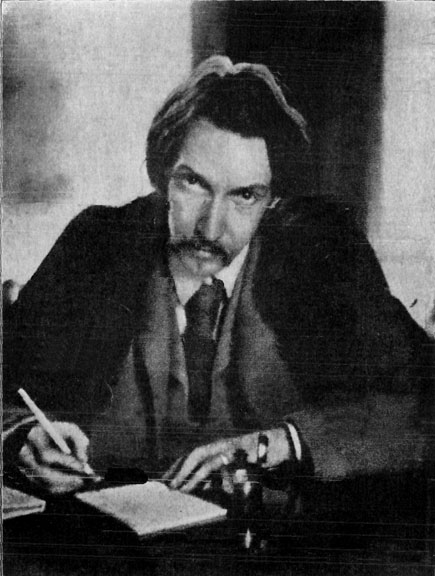
Robert Louis Stevenson was a Scottish novelist, poet, essayist and travel writer born November 13, 1850. His parents were Margaret Isabella Balfour and Thomas Stevenson. Margaret Isabella Balfour came from a family of lawyers and church ministers. Thomas Stevenson, an engineer, came from a family of well known engineers who built most of the deep sea light houses around the coast of Scotland.
Stevenson’s mother was often very ill, and much of his education was left to his nurse, Alison Cunningham, whom Stevenson often referred to as "Cummy." Cummy was very religious and taught Stevenson extreme Calvinist doctrine. Stevenson was also sickly like his mother and this religious education helped him persevere through his times of sickness, although he later became agnostic.
Stevenson attended the University of Edinburgh to follow the family tradition and study engineering. He eventually compromised with his father, saying that he would study law despite his true ambition to become a writer. In 1875, Stevenson passed the Scottish bar but did not practice. Instead, he spent time pursuing his goal of becoming a writer and traveling to France to live a Bohemian lifestyle. His first works described traveling in France and his experiences there.
In 1876, he began a romantic relationship with a cougar named Fanny Osbourne, who was married with two children. In 1879, she divorced her husband and married Stevenson in 1880. Funded by Stevenson’s father, the couple spent a good deal of time traveling. Stevenson wrote The Strange Case of Dr. Jekyll and Mr. Hyde in 1885. Stevenson wrote the first draft in three days, but he later destroyed it after Fanny criticized it for being a piece of sensational literature rather than a masterpiece. The second draft, the one that we are reading, is not as good as the first according to Stevenson.
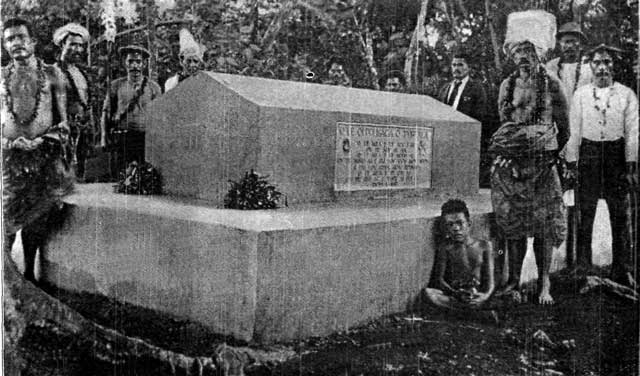
In 1888, the Stevenson’s hired a yacht and sailed to the Polynesian Islands. In 1890 they settled in Samoa, where Stevenson would die in 1894.
Victorian Cultural Perspective:
In the novella The Strange Case of Dr. Jekyll and Mr. Hyde, Mr. Hyde visits the slum area of Soho to pursue his desires. Because of Darwin’s widely accepted theories on evolution, many Victorians (especially those of the upper class) believed that devolution or degeneration was possible and that areas of town like Soho, with their venues for sleazy entertainment and wide-spread prostitution, were evidence of the degeneration of the human race. Victorians would see characters like Mr. Utterson and Dr. Jekyll, civilized white British males, at the pinnacle of the evolutionary hierarchy. On the other hand, they would consider the character Mr. Hyde, with his savage nature, as a lower form of existence.
This is the full movie. Fast forward to 24:53 minutes to watch Dr. Jekyll transform into Hyde.
Stevenson’s influence on Modern Culture:
Stevenson’s ideas of dual nature have influenced our modern film and literature. The Incredible Hulk, Batman, the movie Hide and Seek, and others are evidence of Stevenson’s influence. Click on the link to see the similarities in the transformations.
Tuesday, March 9, 2010
Almost Alice
Sorry to keep posting stuff about the movie, but I was really excited about it and am very happy it finally came out!!
There is an album of music inspired by the film called Almost Alice. I was listening to it on iTunes the other day, and Franz Ferdinand did a musical rendition of "The Lobster Quadrille" how cool is that?! It's pretty gloomy yet catchy, and I think it captures the poem rather well!
There is an album of music inspired by the film called Almost Alice. I was listening to it on iTunes the other day, and Franz Ferdinand did a musical rendition of "The Lobster Quadrille" how cool is that?! It's pretty gloomy yet catchy, and I think it captures the poem rather well!
Alice goes to China
I remain completely shocked by the ending event of Tim Burton's new film, "Alice in Wonderland." While I enjoyed overall Burton's interpretation/amalgamation of Lewis Carroll's two tales, _Alice's Adventures in Wonderland_ and _Through the Looking Glass_, I was completely thrown by the following three elements:
1. Alice goes to China at the film's close. She essentially becomes the ultimate imperialist, realizing how she can extend the imperial commerce plans of her now-deceased father beyond even his own mad fancies. Thus, Alice is made to grow up (again), not into the proper, subdued, domestic woman, but a "new woman" who inherits the colonizer's mantle. I'm not sure which is better or worse. Or if, in fact, Alice is a doomed character, whose trips down the rabbit hole will be a life long process of growing up again and again. After all, while down the rabbit hole, she must grow up, grow down, grow up, grow down, and grow up again, depending on which substance she ingests at any particular time. Consequently, "growing up" is a mere illusion?
2. Why is the "Mad Hatter" (played wonderfully by Johnny Depp) a cross b/w an imbecile and a Scot? I couldn't figure out the Scottish allusion. Carroll himself had Irish roots. Does Burton have Scottish roots? Is there some jab at the Scots I should be aware of? (I just don't get it.)
3. Why was Alice Liddell changed to Alice Kingsley? I assumed we were talking about Henry Kingsley as the allusion--i.e. the brother of Charles Kingsley, who wrote the contemporary novel, _The Water-babies_. But just prior to the closing scene of the film, we find out that Alice's father's name was CHARLES Kingsley. Is this Burton conflating Henry Kingsley w/ Charles Dodgson (aka Lewis Carroll), or is Burton perhaps implying he's planning to make _The Water-babies_ into a similarly delightful film? Or, was it just an unintended consequence, one that only a reader of Victorian lit would construct?
Oh. and I do have a 4th element that threw me: the 3D showing of the film. Bleck! Aside from the random flecks of dust, mingling and floating in the sunbeams, I found the 3D distracting and headache inducing. In fact, this technique served to reinforce the fact that I was watching a movie, rather than allowing me to truly get lost in it. There is something to be said, after all, for the strength of the imagination over technology.
1. Alice goes to China at the film's close. She essentially becomes the ultimate imperialist, realizing how she can extend the imperial commerce plans of her now-deceased father beyond even his own mad fancies. Thus, Alice is made to grow up (again), not into the proper, subdued, domestic woman, but a "new woman" who inherits the colonizer's mantle. I'm not sure which is better or worse. Or if, in fact, Alice is a doomed character, whose trips down the rabbit hole will be a life long process of growing up again and again. After all, while down the rabbit hole, she must grow up, grow down, grow up, grow down, and grow up again, depending on which substance she ingests at any particular time. Consequently, "growing up" is a mere illusion?
2. Why is the "Mad Hatter" (played wonderfully by Johnny Depp) a cross b/w an imbecile and a Scot? I couldn't figure out the Scottish allusion. Carroll himself had Irish roots. Does Burton have Scottish roots? Is there some jab at the Scots I should be aware of? (I just don't get it.)
3. Why was Alice Liddell changed to Alice Kingsley? I assumed we were talking about Henry Kingsley as the allusion--i.e. the brother of Charles Kingsley, who wrote the contemporary novel, _The Water-babies_. But just prior to the closing scene of the film, we find out that Alice's father's name was CHARLES Kingsley. Is this Burton conflating Henry Kingsley w/ Charles Dodgson (aka Lewis Carroll), or is Burton perhaps implying he's planning to make _The Water-babies_ into a similarly delightful film? Or, was it just an unintended consequence, one that only a reader of Victorian lit would construct?
Oh. and I do have a 4th element that threw me: the 3D showing of the film. Bleck! Aside from the random flecks of dust, mingling and floating in the sunbeams, I found the 3D distracting and headache inducing. In fact, this technique served to reinforce the fact that I was watching a movie, rather than allowing me to truly get lost in it. There is something to be said, after all, for the strength of the imagination over technology.
Subscribe to:
Posts (Atom)